This guide is written for independent urologists, practice owners, administrators, and credentialing or revenue-cycle staff. Get this wrong and the fallout touches patient safety, compliance, scheduling, and cash flow all at once.
Credentialing gets mentioned constantly during provider onboarding, and it's frequently confused with privileging, payer enrollment, and contracting. They're related but not interchangeable. Below, we walk through what credentialing actually involves, how the process unfolds, what commonly derails it, and how to prepare.
Key Takeaways
- Primary-source checks confirm education, training, licensure, and professional standing, not self-reported claims alone
- Credentialing, privileging, and payer enrollment are three distinct approvals, though a urologist typically needs all three
- Complete documentation and fast responses to verification requests reduce delays; exact requirements still vary by payer and state
- Approval is not the finish line: monitoring, renewals, and periodic recredentialing continue afterward
What Is Provider Credentialing for Urology Practices?
In plain terms, credentialing answers one question: does this clinician meet the qualifications and professional standards required by the organization reviewing them? That organization might be a urology group, a hospital medical staff office, an ambulatory surgery center, or a health plan.
Who goes through it: Credentialing applies to urologists, fellows transitioning into independent practice, nurse practitioners, physician assistants, and any clinician whose services require organizational approval before billing or scheduling.
Reviewers typically examine:
- Medical school, residency, and fellowship training records
- State medical licenses and DEA registration where applicable
- Board certification status
- Malpractice coverage and claims history
- Work history, gaps, and professional references
- Hospital affiliations, sanctions, and disciplinary actions
Credentialing vs. Privileging vs. Enrollment vs. Contracting
These four terms get used loosely, and that's where confusion creeps in:
| Process | What it determines | What it is not |
|---|---|---|
| Credentialing | Whether the provider's qualifications and professional standing meet the organization's standards | Not proof of facility privileges or payer approval |
| Privileging | Which specific procedures the provider may perform at a given facility, based on training and documented competence | Not automatic once credentialing is complete |
| Payer enrollment | Whether the provider is set up to bill Medicare, Medicaid, or a commercial plan for covered services | Not the same as being in-network under a signed contract |
| Payer contracting | The reimbursement and network terms both parties agree to | Not evidence that credentialing or enrollment has finished |
A urologist can be fully credentialed at a hospital and still lack privileges for a specific robotic procedure until a separate competency review happens. Similarly, being enrolled with a payer doesn't mean every service line is covered under a signed contract.
Why Provider Credentialing Matters in Urology
Credentialing exists first as a patient-safety mechanism. It confirms, through primary sources rather than assumption, that the clinician performing a cystoscopy or robotic prostatectomy actually has the training and active license to do so.
For urology specifically, that extends into procedure-level review. Surgical privileges, hospital call coverage, and supervision arrangements for advanced practice providers all depend on credentialing being accurate and current.
The financial exposure is where many practices get surprised.
CMS's NPI fact sheet makes a point worth repeating: obtaining a National Provider Identifier does not establish licensure, credentialing, or health-plan enrollment, and a provider doesn't get paid by Medicare until properly enrolled. An NPI is a prerequisite, not an approval.
Timing matters too. Under Medicare's enrollment rules, eligible physicians and practitioners can generally bill retrospectively for up to 30 days before their enrollment effective date, extended to 90 days after a qualifying disaster, according to Medicare's enrollment manual. Miss that window and earlier services may simply fall outside what's collectable.
The practice impact shows up in denial data. In MGMA's 2021 poll, 54% of responding practices reported rising credentialing-related denials.

That's a reported trend across practices, not a universal claim-denial rate. It still tracks with what shows up in urology revenue-cycle reviews:
- Stalls scheduling when files are incomplete
- Delays payer participation
- Pushes a provider's claims out-of-network entirely
A quick note on scope: some of these rules are federal (Medicare enrollment timing), some are state-specific (licensure and supervision requirements), and some are purely internal policy. Treat them accordingly rather than assuming one rule applies everywhere.
How the Urology Provider Credentialing Process Works
Credentialing flows from defining scope, through application and verification, to a decision, then into ongoing monitoring. Here's how that breaks down in practice.
Define the credentialing scope. Identify every place the provider will practice and bill, including the group itself, affiliated hospitals, ASCs, telehealth arrangements, and target payers. List which procedures require separate privileges and confirm the relevant bylaws and supervision rules.
Collect the application and supporting documents. This means a complete application, current CV, education and training history, licenses, board certification, NPI and taxonomy details, malpractice coverage, work history, and references. Employment gaps, name changes, and expired documents need explanations upfront, not silence.
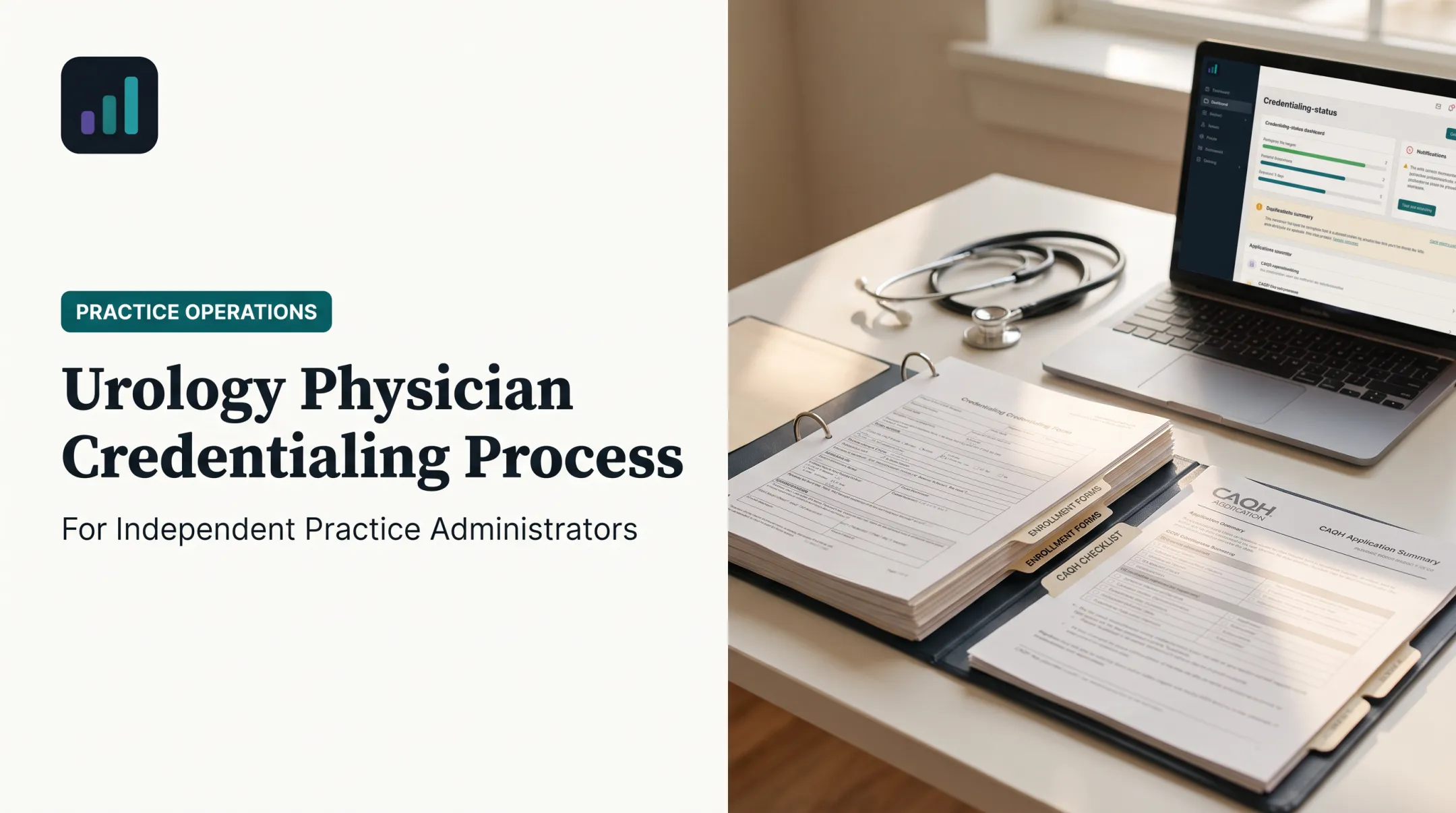
Perform primary source verification. This is the core of credentialing: confirming credentials directly with the issuing institution, not just accepting copies. For urologists, that includes the American Board of Urology for certification status, state licensing boards, and databases like the National Practitioner Data Bank and CAQH.
Review professional history and risk information. Licenses, certifications, hospital affiliations, malpractice history, and sanctions all get checked. Discrepancies should trigger a documented request for clarification, not an automatic denial, unless written policy says otherwise.
Obtain the decision. Outcomes include approval, conditional approval, deferral, or denial, decided under the organization's governance structure. Approval here doesn't automatically grant every procedure privilege or guarantee payer participation.
Maintain the file after approval. License renewals, sanctions checks, malpractice updates, and recredentialing cycles continue indefinitely. The exact recredentialing interval varies by organization, so confirm the actual cycle rather than assuming a standard timeline.

GrowUrology's internal guidance on launching an independent practice treats this sequence as a critical path. Credentialing and payer enrollment, not build-out, usually determine a practice's first collection date. Start the work roughly six months before opening, well before signing a lease.
Where Credentialing Fits in Urology Practice Operations
Credentialing doesn't sit in isolation. It touches hiring, scheduling, hospital coverage, and billing all at once.
Who owns what:
- The provider supplies accurate, complete information
- A practice administrator or credentialing coordinator manages the file and tracks deadlines
- Facility committees review privileges separately from the practice's own credentialing
- Payers process enrollment and participation requests on their own timeline
Common triggers for starting or updating credentialing include:
- Hiring a new clinician
- Adding a payer
- Opening a second location
- Affiliating with a new hospital
- Adding a procedure line
- Changing ownership or tax ID
- Responding to a license renewal
Some of this work is one-time per application. Other parts, like monitoring and recredentialing, recur for the life of the provider's affiliation.
GrowUrology recommends sequencing payers by expected patient volume rather than ease of enrollment. Getting approved quickly with a carrier that represents a small share of the panel doesn't move the needle on payroll.
Key Factors That Affect Urology Credentialing
Several variables determine how smoothly credentialing goes:
| Factor | Why it matters |
|---|---|
| Provider documentation | Completeness and consistency across applications, CVs, and disclosures directly affects review speed |
| Verification source response times | Medical schools, state boards, and certification bodies each move at their own pace |
| Facility requirements | Procedure privileges, ASC rules, and medical staff bylaws vary by location |
| Payer and enrollment rules | Medicare, Medicaid, and commercial plans each have distinct processes, and CAQH profiles require re-attestation periodically |
| Monitoring and renewal controls | Expiration tracking and clear ownership prevent lapses between recredentialing cycles |
A group NPI, tax ID, bank account, and CAQH profile need to be set up correctly before any payer-facing work begins. Errors at that foundational level cascade into every enrollment that follows.

Common Issues and When Credentialing May Not Be Appropriate
A few misconceptions cause recurring problems:
- Credentialing is not a background check alone
- A state license doesn't establish facility privileges on its own
- Payer enrollment doesn't authorize every procedure a provider might perform
- Approval at one organization does not transfer automatically to another
Frequent causes of delay include:
- Incomplete applications or inconsistent CV dates
- Missing training verification
- Expired licenses
- Unresolved malpractice disclosures
- Slow responses from primary sources
- Mixing the individual provider's file with the group's billing entity
Some situations call for a different process entirely, such as straightforward employment screening, a standalone privileging review, or a change-of-scope request when a provider adds a new procedure. An experienced urologist credentialed elsewhere still needs a full review at each new organization.
Practical controls that help:
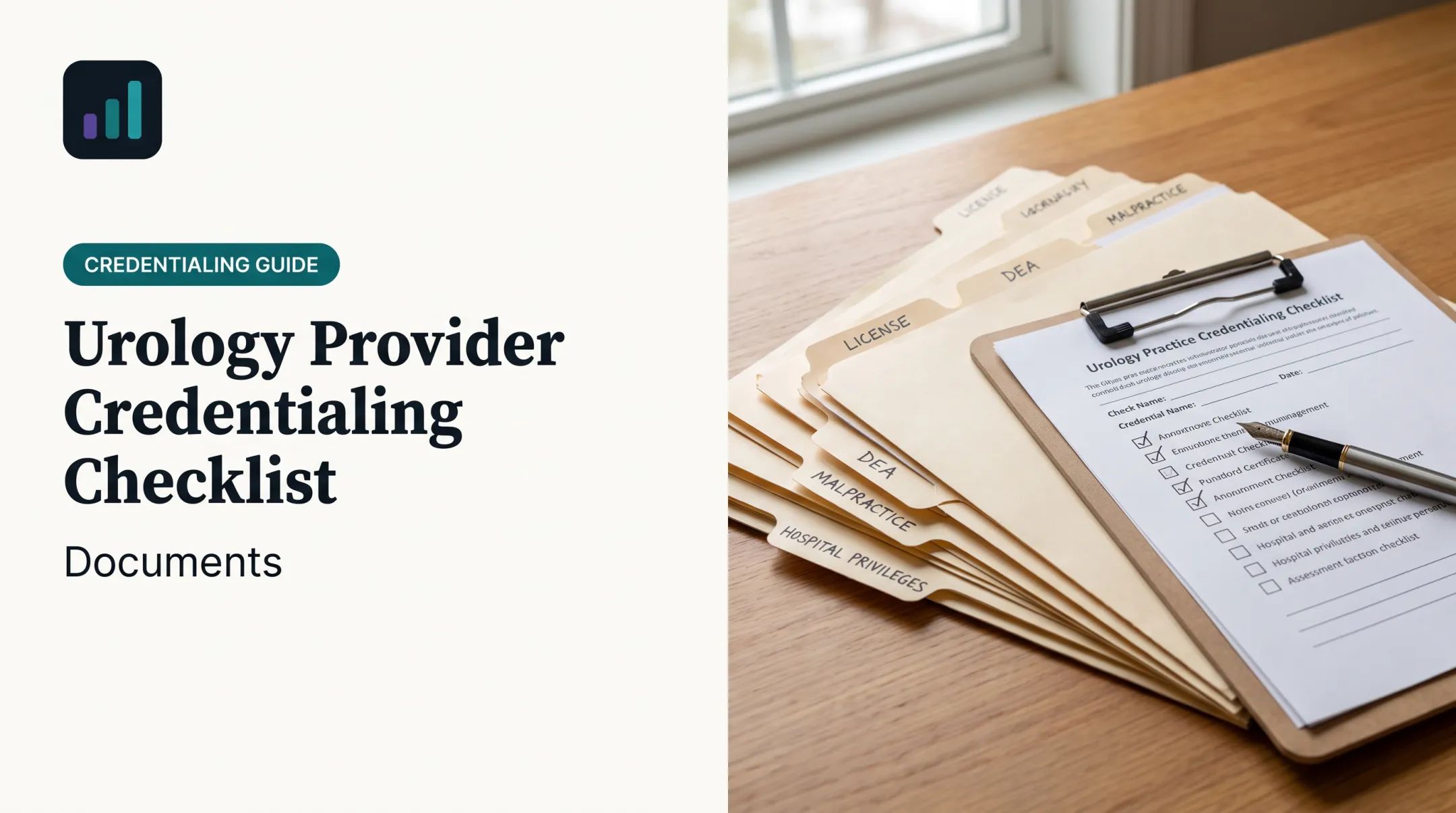
- Use a document checklist for every application
- Assign one owner per payer or facility relationship
- Track every request and response with dates
- Set renewal reminders well ahead of expiration
- Escalate unresolved discrepancies according to written policy
For the broader financial and revenue-cycle implications of onboarding and credentialing, GrowUrology's free resources cover practice economics in more depth, though the site itself doesn't perform credentialing work.
Conclusion
Urology provider credentialing is a structured verification and decision process, confirming whether a clinician is qualified, in good standing, and appropriate for a specific practice, facility, or payer relationship. The work does not end when the initial forms are submitted.
What matters most:
- Accurate documentation
- Genuine primary source verification
- A clear line between credentialing, privileging, and payer enrollment
- Ongoing monitoring after approval
For independent practices, the practical move is straightforward. Map requirements by provider, facility, payer, and procedure, assign clear accountability for each, and confirm current U.S. rules before letting a credentialing decision drive scheduling or billing.
Frequently Asked Questions
How much does provider credentialing cost?
Cost varies by provider type, number of facilities and payers involved, internal staffing, and whether work is outsourced. Get an organization-specific estimate rather than relying on a generic figure, since delayed revenue from incomplete credentialing often outweighs the direct cost.
How does provider credentialing work?
Credentialing starts with a complete application, then primary-source verification, review of professional and risk history, and an organizational decision. Privileging and payer enrollment follow, with ongoing monitoring after approval.
What happens if a provider is not credentialed?
Depending on which approval is missing, the provider may be unable to practice at a facility, perform certain procedures, join a payer network, or bill for services. Specific consequences vary by organization and payer.
Is provider credentialing difficult?
It's detail-intensive, involving multiple sources, deadlines, and regulatory requirements that shift by state and payer. Checklists, clear task ownership, and centralized tracking make the workload manageable even when it's not simple.