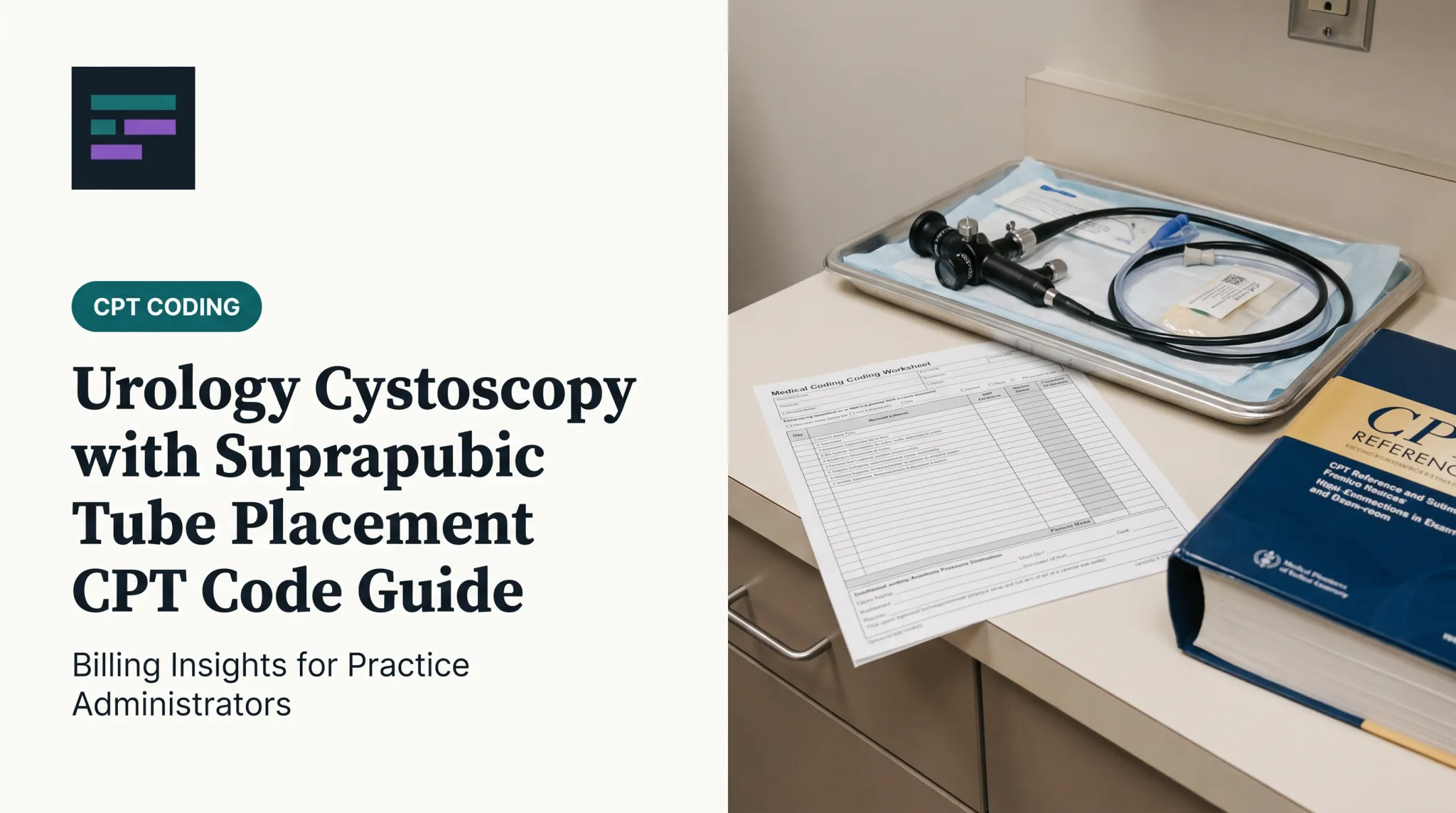
Urology Cystoscopy CPT Codes: Ureteral Stent Placement Billing Guide
Every stent case starts with the same question: what did the urologist actually do? Diagnostic cystoscopy only? Indwelling stent placement? A ureteroscopy that happened to involve the bladder on the way in? Stent removal in the office?
That answer, not the diagnosis, drives correct CPT selection. Get it wrong and you're looking at bundling errors, medical-necessity denials, or an audit flag that costs more than the claim was worth.
This guide walks through CPT 52332 and the related cystoscopy, ureteroscopy, and stent-removal codes urology practices bill most often. It covers modifiers, documentation, and the payer-specific checks that have to happen before a claim goes out.
One note up front: CPT descriptors, NCCI edits, and payer rules change. Verify everything here against current AMA, CMS, and payer sources before you bill.
Key Takeaways
- Code the most comprehensive documented service, not diagnostic cystoscopy plus a therapeutic add-on
- Evaluate CPT 52332 for cystoscopic insertion of an indwelling ureteral stent, subject to current descriptors
- Confirm laterality and bilateral-reporting format before choosing modifier 50 versus RT/LT
- Require the operative note to support the procedure, indication, device status, and complexity
- Missing RT/LT on ureteral procedures remains one of the cleanest, most avoidable rejections
How to Choose the Correct Cystoscopy or Related CPT Code
The most common cystoscopy billing mistake is coding based on what the urologist found rather than what they did. A stone that wasn't treated this visit doesn't change the code. A stent that was placed does.
Start with the diagnostic-versus-therapeutic split. CPT 52000 covers a diagnostic cystourethroscopic examination, but verify its current descriptor and bundling instructions before using it. If the encounter included any treatment, 52000 likely gets absorbed into that treatment code instead of billed alongside it.
Build a Code-Selection Sequence Around What Happened
Walk through the documented intervention in order:
- Diagnostic examination only: check whether CPT 52000 applies as-is
- Bladder biopsy, fulguration, tumor resection, dilation, or injection: research the specific therapeutic code rather than defaulting to 52000
- Indwelling ureteral stent insertion: evaluate CPT 52332 and related ureteroscopy codes
- Stent, calculus, or foreign-body removal: compare CPT 52310 against CPT 52315 based on documented complexity
Ureteroscopy complicates this further. A comprehensive ureteroscopy code can include cystoscopic access or stent-related work as a component, so a separate stent-placement charge may not be appropriate for that same procedure.
The American Urological Association's coding update flags this pattern for certain code pairs. Components already folded into a more comprehensive ureteroscopy service should not generate a duplicate charge, according to AUA's CodingPlus guidance.
Don't code from a fee schedule or cheat sheet alone. The operative report, the actual work performed, current CPT instructions, NCCI edits, payer policy, and place of service all have to line up before you submit.

Billing CPT 52332 for Ureteral Stent Placement
CPT 52332 is the primary code for cystoscopic insertion of an indwelling ureteral stent. Reproduce the current official descriptor only after checking a licensed AMA source; public summaries aren't a substitute.
The clinical distinction that matters most is an indwelling, self-retaining stent that stays in the patient versus a temporary catheter or stent used and removed within the same ureteroscopy.
CMS's 2026 bundling guidance treats temporary insertion and removal during a diagnostic or therapeutic ureteroscopy as integral to that procedure, not separately billable. The device has to remain in place after the case ends for 52332 to apply on its own.
What the Operative Note Needs to Support 52332
- Indication for placement and the relevant diagnosis
- Side treated (right, left, or bilateral)
- Stent type or identifying description, when relevant to the payer
- Placement technique and confirmation that the stent remained indwelling
- Any associated ureteroscopy, lithotripsy, stone extraction, or retrograde work
Bilateral reporting varies by payer. Some payers want modifier 50 on a single line. Others want RT and LT on two separate lines. Facility claims in an ASC setting often follow a different format than professional claims. Research the specific payer's instruction rather than assuming a universal approach.
Same-session reporting with ureteroscopy or stone treatment follows standard code-selection logic: the most comprehensive applicable code controls. Whether 52332 is separately reportable depends on the exact procedure, the stent's final status, and payer-specific rules.

Pre-Submission Checklist for 52332 Claims
- Prior authorization confirmed, if required
- Diagnosis supports medical necessity
- Laterality documented and matches the claim
- Place of service recorded correctly
- Device documentation present
- Code-year validity checked
- NCCI edits and MUEs reviewed
- Payer-specific billing instructions followed
Stent Removal, CPT 52310 and CPT 52315, and Related Bundling Rules
Removal coding splits on complexity: simple versus complicated. The word "difficult" in a note isn't enough on its own. The documentation needs to spell out what made the removal complicated, not just assert that it was.
A frequent question coders run into is what actually separates CPT 52310 from CPT 52315. There's no verified universal time threshold or stent-count rule that automatically bumps a case into the complicated category. The operative note needs to describe the specific additional maneuvers, obstacles, or extra work involved, and code selection has to follow that documentation along with current payer policy.
Watch These Bundling Scenarios
- Diagnostic cystoscopy billed alongside stent placement at the same encounter
- Cystoscopy performed as part of a ureteroscopy
- Retrograde studies performed with another urinary tract procedure
- Cystoscopy performed during a separate surgical service
CMS designates 52310 and 52315 as separate-procedure codes, meaning they generally shouldn't be reported alongside other cystourethroscopy codes at the same encounter. Don't assume cystoscopic examination tied to a removal is separately billable. Check current guidance first.
Bilateral Removal Needs Its Own Check
Two stents don't automatically mean two units, and modifier 50 isn't automatically accepted for bladder-level removal work the way it might be for paired ureteral procedures. Research current Medicare MUE and bilateral-reporting rules for both codes, and require documentation of both sides before applying any multiplier.
A quick modifier review:
| Modifier | When it applies |
|---|---|
| 25 | Significant, separately identifiable E/M on the same day as the procedure |
| 59 / X{EPSU} | A genuinely distinct procedural service, not a routine add-on |
| RT / LT | Laterality, when the payer directs their use over 59 or XS |
| 50 | Eligible bilateral procedures only, not multiple devices |
CMS is explicit that modifiers require documented justification. You don't attach 59 simply to get past an edit, according to CMS's modifier guidance. A modifier is not a substitute for a genuinely distinct procedural circumstance.
Cystoscopy and Ureteral Stent Documentation Checklist
A correct code with a thin note still gets denied. The documentation has to carry the medical necessity, not just the procedure name.
Core elements every operative note should capture:
- Indication, preoperative diagnosis, postoperative diagnosis
- Procedure performed, scope and technique used
- Findings and any intervention
- Stent status: placed, removed, or exchanged
- Laterality for every side treated
- Associated procedures (ureteroscopy, lithotripsy, retrograde imaging, stone extraction)
- Complications and disposition
Matching Documentation to the Decision It Supports
| Coding decision | What the note must show |
|---|---|
| Diagnostic-only vs. therapeutic | Whether any treatment occurred, not just findings |
| Indwelling stent vs. temporary catheter | Device status at the end of the case |
| Unilateral vs. bilateral | Each side's work, not just "bilateral" as a label |
| Simple vs. complicated removal | Specific added maneuvers or difficulty |
A vague note ("cystoscopy performed, stent removed, no complications") gives the coder nothing to work with on complexity or laterality. A complete note that names the side, describes the technique, and flags any added difficulty gives the claim something to stand on.
Before submission, compare the operative note, the charge capture record, and the claim lines against each other. Mismatches between what was documented and what was billed are an easy, self-inflicted denial.

Denial Prevention and a Repeatable Billing Workflow
Most cystoscopy and stent denials trace back to one of four recurring patterns. The usual culprits are diagnostic cystoscopy billed with a therapeutic service, missing or incorrect laterality, unsupported bilateral units, and modifier 59 applied without a genuinely distinct service.
A Five-Step Workflow Before Any Claim Goes Out
- Identify the actual service performed, not the scheduled procedure
- Select the most comprehensive code that matches the documented work
- Check bundling and modifiers against current NCCI edits
- Validate documentation and authorization against payer requirements
- Review the claim against payer-specific billing instructions
Denial patterns worth tracking on a recurring basis:
- Diagnostic cystoscopy billed with a therapeutic procedure at the same encounter
- Incorrect or missing stent laterality
- Bilateral units billed without supporting documentation
- Modifier 59 used to override a legitimate bundle
- Simple removal upgraded to complicated without a documented basis
- Missing authorization or medical-necessity support
Your own denial data is more useful here than any industry average. Sorting denials by root cause and dollar value, rather than by payer, tells you why claims fail instead of just who is denying them.
Independent urology practices evaluating their own coding and revenue-cycle patterns can run a GrowUrology practice assessment to see where denials and underpayments are concentrated. Any default figures in that kind of tool should be treated as illustrative, not as validated benchmarks for your practice.
Build in a periodic review of CPT updates, payer bulletins, NCCI edits, fee schedules, authorization requirements, and any chargemaster or EHR changes. Codes and edits move quarterly. A workflow built on last year's assumptions is already behind.
Frequently Asked Questions
What is the CPT code for a cystoscopy with ureteral stent insertion?
CPT 52332 is the code for cystoscopic insertion of an indwelling ureteral stent. Verify the current descriptor, associated procedures, laterality, and payer-specific rules before submitting.
What is the CPT code for removing a ureteral stent?
CPT 52310 or CPT 52315 may apply, depending on whether the removal was simple or complicated. Check current payer rules on units and bilateral reporting before billing either code.
What is the description of CPT code 52315?
CPT 52315 covers complicated cystoscopic removal of a foreign body, calculus, or stent. The operative note must document what specifically made the removal complicated . Rely on the current licensed CPT descriptor, not a summarized version.
What is the CPT code for a cystoscopy procedure?
It depends on whether the cystoscopy was diagnostic only or included a therapeutic intervention. CPT 52000 may apply to a diagnostic-only exam, but verify its current descriptor and bundling instructions first.
What is the procedure for removing a ureteral stent?
Stent removal is typically done cystoscopically in the office or an outpatient setting. The exact technique and any added complexity should be documented clearly for coding . Clinical instructions always come from the treating urologist.
What is a cystoscopy with insertion of a ureteral stent used for?
An indwelling ureteral stent maintains urine drainage and ureteral patency, often after stone treatment or in cases of obstruction. The specific clinical indication and any associated procedure determine how the encounter is documented and billed.