Credentialing and payer enrollment, not construction or equipment delivery, usually set a new urology practice's first collection date. A finished exam room means little if the effective date with your highest-volume payer hasn't landed yet.
Credentialing is frequently discussed alongside enrollment, contracting, and billing setup, but each has distinct requirements and failure points that get confused at the operational level. This article covers what credentialing actually verifies, the documents and workflow involved, realistic timelines, and the urology-specific details, including hospital privileges and ASC relationships, that trip up practices treating credentialing as a one-time task.
Key Takeaways
- Credentialing verifies a provider's qualifications; enrollment and contracting establish the payer relationship and reimbursement pathway
- Gather individual, group, location, hospital-affiliation, licensing, insurance, and billing documentation before applying
- CAQH centralizes provider data for participating payers but doesn't replace payer-specific applications or government enrollment
- Approval timing varies by payer, completeness, and verification responses; phase limits exist, but no universal average does
- Recredentialing, document renewal, and status monitoring keep credentials active after approval
What Is Insurance Company Credentialing for Urology Providers?
Credentialing is a payer's formal review of a urology provider's education, training, licensure, board certification, work history, malpractice coverage, professional standing, and practice information. NCQA's 2025 credentialing guide describes this as evaluating academic qualifications and clinical practice history to support a safe, accountable network.
The outcome is straightforward: the payer decides whether a provider meets its network standards and may be recognized as eligible to deliver covered services under that payer's rules. That's it. Credentialing on its own doesn't activate billing.
Credentialing Is Not the Same as Enrollment or Contracting
Practices often conflate four distinct processes that each need separate sign-off:
| Process | What it establishes |
|---|---|
| Credentialing | Verifies qualifications and professional eligibility |
| Payer enrollment | Links the provider or group to a payer system, program, billing identifier, and effective date |
| Contracting | Sets participation terms, reimbursement provisions, and covered services |
| Claims setup | Enables submission and reconciliation once approvals and effective dates are active |
A urology provider can hold a valid state medical license and a fully completed CAQH profile and still lack payer-specific approval, an active contract, location enrollment, or a billable effective date. One doesn't substitute for the others.
Who's Involved
Several parties typically touch a single credentialing file:
- The urology provider and the group practice
- The payer's credentialing department or a credentials verification organization (CVO)
- The practice administrator and billing team
- Hospital or ambulatory surgery center (ASC) partners, when privileges are part of the review
Regulatory specifics vary by state and payer, so always confirm current requirements with CMS, CAQH, your state licensing board, and the payer directly before submitting.
Why Credentialing Is Used in Urology Practice Operations
Credentialing supports payer review of provider qualifications, network standards, and compliance. It does not, by itself, guarantee clinical quality or payment. That distinction matters because practices sometimes treat an approval letter as the finish line when it's really a checkpoint.
Without completed credentialing and enrollment, a urology practice cannot reliably bill or appear in-network across commercial insurance, Medicare, Medicaid, and other plans. Each plan follows its own program rules.
When Urology Practices Need to Plan Ahead
Several urology-specific scenarios make early credentialing planning non-negotiable:
- Onboarding a new physician, whether joining an existing group or launching independently
- Opening an additional office location
- Establishing hospital or ambulatory facility relationships
- Expanding into a new specialty procedure line
- Changing group ownership or tax identification
Payer enrollment timelines vary widely by carrier, state, and whether the incoming provider joins an existing group tax ID or stands up a new one. Errors in entity or NPI information at this stage cascade into every downstream enrollment, so it's worth getting right the first time rather than fixing it across a dozen payer applications later.
What Goes Wrong When Credentialing Lags
Incomplete or delayed credentialing creates predictable downstream problems:
- Claims get rejected or held pending verification
- Patients receive inaccurate in-network information
- Provider directories list the wrong status or location
- Administrative teams spend hours on avoidable rework instead of patient-facing tasks
These problems are the operational cost of treating credentialing as an afterthought rather than a critical-path item.

How the Credentialing Process Works for Urology Practices
The full workflow runs from deciding which payers and locations matter to your practice, through documentation, application, verification, approval, contracting or enrollment, billing setup, and ongoing maintenance.
Step 1: Identify Target Payers, Provider Types, and Practice Relationships
Prioritize payers based on patient mix, service locations, referral relationships, and your local market. Confirm whether the application covers an individual provider, a group, a facility, a new location, or some combination.
Sequence matters here. A carrier representing a small sliver of your expected panel won't help make payroll if it gets enrolled first while your highest-volume payer sits in a queue. Rank by expected volume, not by which application looks easiest to finish.
Step 2: Build the Credentialing File
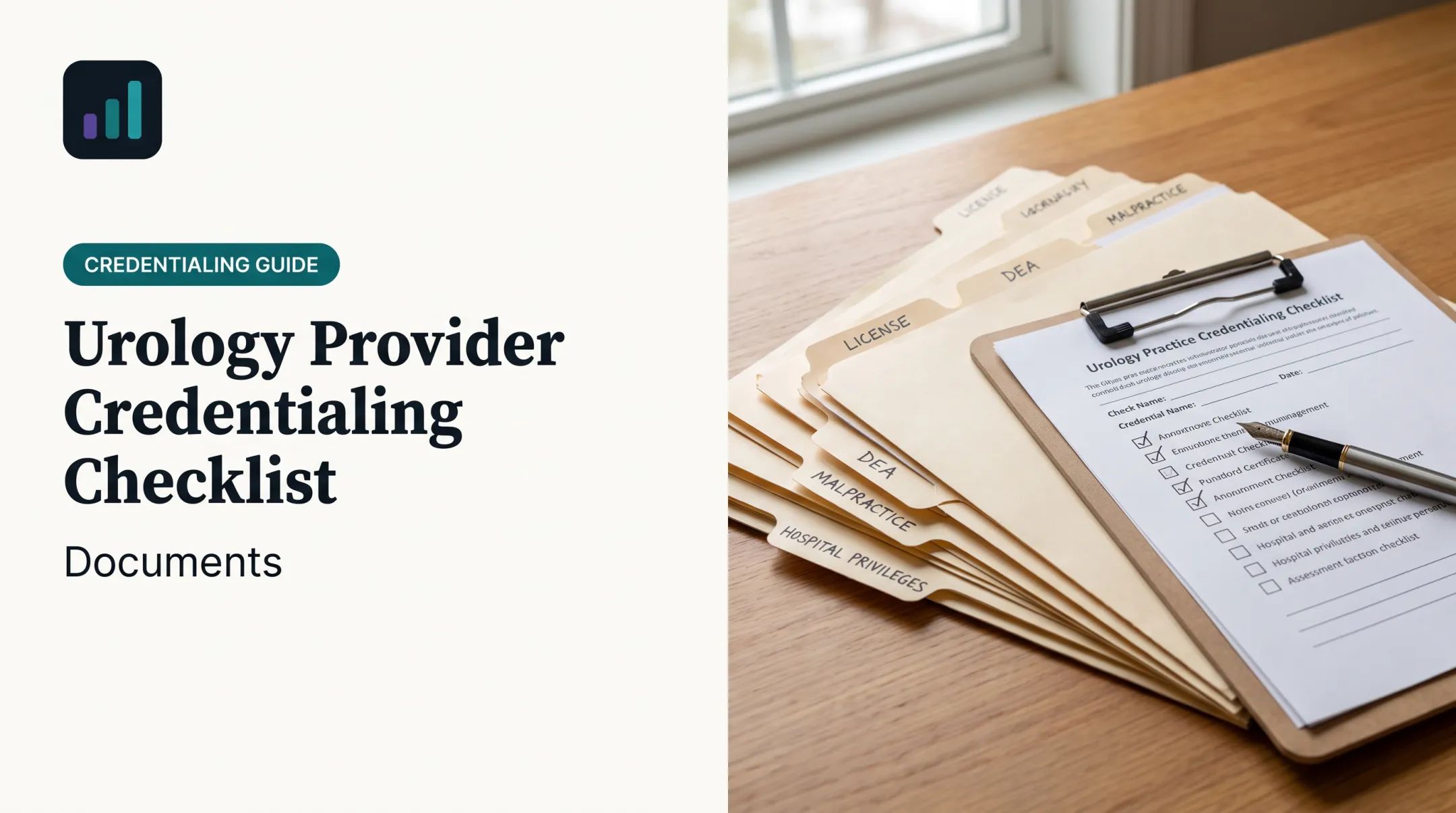
Core documents typically include:
- Current CV or work history, with gaps explained
- Medical degree, residency, and fellowship records
- State medical licenses and board certification
- DEA registration, where applicable
- Malpractice coverage documentation
- NPI information and tax documentation
- Professional references
Urology practices also need separate verification for hospital affiliations, admitting or surgical privileges, ASC relationships, and procedure scope.
Keep legal names, addresses, taxonomy codes, NPI, tax ID, and effective dates consistent across CAQH, payer portals, contracts, and claims systems. Mismatches here are one of the most common causes of delay.
Step 3: Complete CAQH and Payer Applications
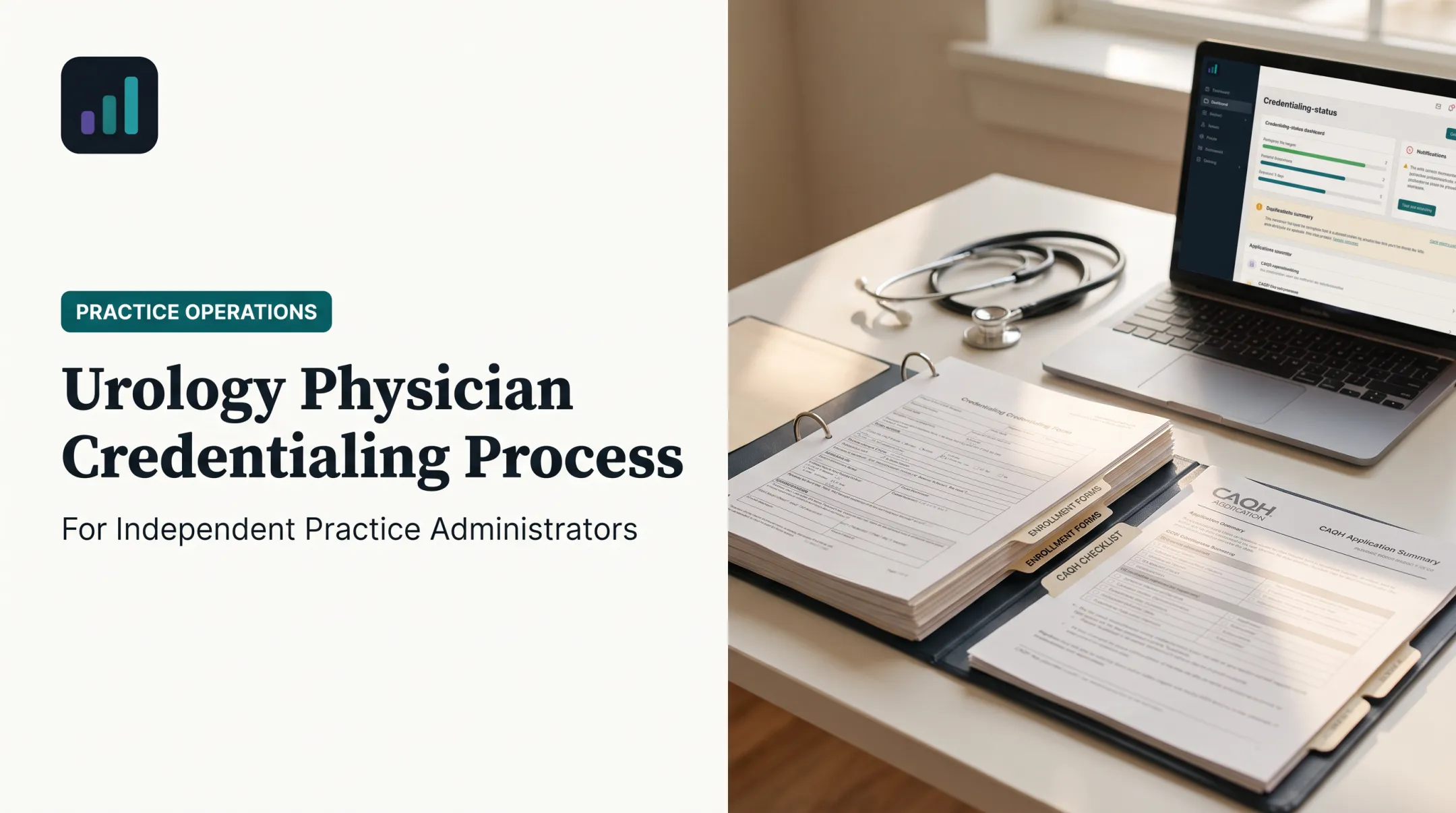
CAQH ProView is the centralized provider-data profile that most commercial payers draw from once a provider authorizes access. It's genuinely useful for reducing duplicate data entry across payers.
It is not a universal substitute. CAQH doesn't replace:
- Medicare or Medicaid enrollment
- Group enrollment
- Contracting
- Payer-specific attestations
Ohio Medicaid, for example, requires its own provider application in addition to a current CAQH profile. Always verify current attestation intervals, upload requirements, and payer participation before relying on it.
Step 4: Verification, Review, Approval, and Activation
Payers verify education, training, licenses, board certification, malpractice history, and work history through primary sources. Discrepancies or unexplained gaps trigger follow-up requests, which is where applications stall.
Timelines vary by payer and program, and published figures describe specific phases rather than a universal average. Texas Medicaid's guidance outlines these phase limits for managed care organizations:
| Stage | Published timing |
|---|---|
| Initial primary-source verification | Up to 15 calendar days after a complete application |
| MCO credentialing-committee review | No more than 60 calendar days after verification is complete |
These figures apply to one state Medicaid program's published process, not a national commercial-payer standard. Don't add them together and present the sum as a typical turnaround; onboarding and contracting steps vary by payer.
Receiving credentialing approval, signing a contract, obtaining an effective date, and confirming claims systems reflect the correct status are four separate milestones. Document submission dates, payer contacts, outstanding requests, and the first date claims may be submitted for each one.

Step 5: Confirm Billing Readiness and Maintain the File
After approval, check that payer IDs, billing NPIs, group affiliations, locations, and taxonomy are correctly loaded into electronic claims and eligibility systems, and that directory listings are accurate.
Then build a recurring process for tracking license renewals, board certification, DEA registration, malpractice coverage, hospital privileges, CAQH attestations, and recredentialing deadlines. This is where credentialing stops being a one-time project and becomes an ongoing operational function.
Key Factors, Common Issues, and Situations Requiring Extra Attention
A practical checklist for urology practices managing multiple payers and providers:
- Provider and group identity: Match legal names, NPIs, tax IDs, taxonomy, and addresses across every record
- Specialty and service scope: Confirm subspecialty, procedures, locations, and facility relationships are represented accurately
- Documentation status: Track expiration dates for licenses, board certification, DEA registration, and malpractice coverage
- Practice changes: Flag when a new location, ownership change, TIN change, or additional provider triggers new credentialing work
- Payer variation: Verify each insurer's rules for CAQH access, open panels, delegated credentialing, and recredentialing cycles
Common Mistakes That Delay Approval
- Submitting an outdated CV or omitting work-history gaps
- Using inconsistent addresses across CAQH, payer portals, and contracts
- Failing to disclose changes in practice status or ownership
- Assuming group approval automatically covers every clinician in it
- Treating CAQH completion as final payer approval
Missed deadlines carry real weight. NCQA's recredentialing FAQ states that the standard commercial recredentialing cycle is 36 months with no grace period, with limited exceptions for active military assignment or medical leave. Missing that window can mean starting initial credentialing over instead of a faster recredentialing path.

When to Get Extra Support
A solo physician in one network might manage credentialing in-house without much strain. A group with several physicians, multiple locations, hospital privileges, and a dozen payer relationships is a different problem entirely. Consider outsourced or hybrid support when:
- Several providers and payers need coordinated tracking
- Individual and group enrollments overlap across multiple locations
- Discrepancies keep surfacing in verification responses
- A small administrative team is already stretched across renewals
In-house management, outsourced support, and a hybrid approach all work, depending on complexity, staff capacity, and how much oversight the practice wants to retain.
Conclusion
Insurance credentialing verifies a urology provider's qualifications and supports network participation, but it's one piece of a larger enrollment, contracting, billing, and revenue-cycle workflow. The strongest process is payer-specific, documentation-driven, tracked from application through effective date, and maintained well after initial approval.
GrowUrology's guide on starting an independent urology practice walks through how credentialing and payer enrollment fit into the first eighteen months of opening a practice, alongside cash-flow planning and revenue-cycle operations. It's a useful planning reference for modeling how credentialing decisions affect your timeline and revenue, though GrowUrology doesn't perform payer credentialing or guarantee approval outcomes.
Frequently Asked Questions
What documents are required for healthcare credentialing?
Common requirements include a current CV, medical degree and residency records, state licenses, board certification, DEA registration, malpractice coverage, NPI and tax documentation, and work-history explanations. Urology practices often need additional hospital-affiliation and privilege documentation, and exact requirements vary by payer.
How long does it take for a provider to get credentialed?
Timing varies by payer, program, and application completeness. Texas Medicaid's published process allows up to 15 days for initial verification and up to 60 additional days for committee review, but these are phase-specific limits, not a universal average.
How often does a provider need to be credentialed?
Initial credentialing happens once per payer relationship, while recredentialing is recurring. NCQA's standard commercial cycle is 36 months with no grace period, though cycles vary by payer, program, and state.
What happens if a provider is not credentialed?
Uncredentialed providers may be unable to bill as in-network, patients may receive inaccurate directory information, and claims can be rejected or held. The specific outcome depends on the payer's rules and program requirements.
What is CAQH credentialing?
CAQH ProView is a centralized provider-data profile that participating payers can access once a provider authorizes it. It streamlines data sharing but doesn't replace payer-specific applications, contracting, or government-program enrollment.