Many independent urology practices treat credentialing as paperwork that runs alongside construction or hiring. It doesn't work that way. An MGMA poll from November 2025 found that only 65% of practices had credentialing files moving on schedule, while 23% reported an active backlog.
This article is written for independent urologists, practice owners, administrators, and credentialing staff. It covers the difference between credentialing, privileging, and payer enrollment, the steps involved, common causes of delay, and how to manage the workflow without losing revenue to avoidable gaps.
Key Takeaways
- Credentialing, privileging, and payer enrollment are separate processes that each need their own tracking and timeline
- Your first billable claim can't predate the effective date with the payer covering your largest patient segment
- Incomplete applications, undisclosed gaps, and expired documents cause most delays
- Start credentialing and enrollment before signing a lease, not after construction begins
- Recredentialing intervals differ by payer, facility, and accreditor, so there's no single renewal date to track
What Is the Urology Physician Credentialing Process?
Credentialing is the documented review an organization uses to decide whether a urologist meets its requirements to provide care. The output isn't a certificate or a badge.
It's a defensible record showing that someone checked the physician's education, licensure, and professional history against primary sources before letting them treat patients under that organization's name.
That distinction matters because credentialing gets confused with three other things it is not:
- A medical license: a state issues that independently
- Board certification: a voluntary credential from a specialty board, not a legal requirement to practice
- A background check or employment screening: narrower processes that may feed into credentialing but don't replace it
Three Related but Separate Stages
According to AMA guidance from 2019, credentialing, privileging, and payer enrollment are distinct administrative tracks:
- Credentialing verifies qualifications and professional history through primary sources
- Privileging authorizes specific clinical services or procedures at a particular facility, based on those verified qualifications plus evidence of competence
- Payer enrollment establishes the provider's participation and billing relationship with Medicare, Medicaid, or commercial plans
Completing one doesn't finish the others. A urologist can be fully credentialed at a hospital and still lack robotic-surgery privileges there. The same physician can hold every privilege they need and still be unable to bill a commercial payer because enrollment hasn't gone through.

Initial credentialing also differs from recredentialing, which revisits the provider's status at intervals set by whichever facility, payer, or accreditor is involved. There's no single clock running here. We'll get into why that matters later.
Why the Credentialing Process Matters for Urology Practices
Credentialing exists to confirm that the person performing a vasectomy reversal or a robotic prostatectomy actually has the training to do so. It verifies education, residency or fellowship completion, licensure, malpractice history, and professional standing against primary sources, not a resume.
For urology specifically, this connects directly to procedure access. Robotic surgery privileging illustrates the stakes well.
The American Urological Association's robotic surgery standard operating procedure distinguishes between recent residency or fellowship graduates (who typically need documented training plus a minimum case volume) and practicing urologists without formal robotic training, who generally need structured retraining and proctored cases before independent privileges are granted. A board certificate alone doesn't satisfy either pathway.
The Revenue-Cycle Connection
Incomplete credentialing doesn't just delay clinical readiness. It delays cash flow.
- A physician hired by an independent practice isn't automatically ready to treat patients, perform procedures, or bill a specific payer
- Those three milestones (hire date, clinical readiness, and billing eligibility) often land on completely different calendars
- Errors in the group NPI, tax ID, bank account, or CAQH profile cascade into every downstream payer enrollment, multiplying a single mistake across every application that references it
This is a pattern GrowUrology's launch planning resources flag directly: credentialing and payer enrollment, not construction or build-out, usually determine a new practice's first collectable claim date. Practices that start these processes after signing a lease are often working against a six-month runway they didn't account for.

Compliance risk runs parallel to the revenue risk. Expired licenses, incomplete malpractice disclosures, unverified training, or unaddressed sanctions create liability exposure that's entirely preventable with a maintained provider file.
How the Urology Physician Credentialing Process Works
The workflow moves through a consistent sequence: the practice defines requirements, the physician supplies documentation, credentialing staff verify it against primary sources, a committee or payer reviews it, and facilities and payers each complete their own separate approvals.

Step 1: Define the Scope and Requirements
Before collecting a single document, identify every entity involved: the practice itself, any hospitals or ambulatory surgery centers, health plans, and delegated credentialing entities. Specify which services and locations matter (office visits, hospital privileges, and the specific urologic procedures the physician will perform) so the application matches their actual intended role rather than a generic template.
Step 2: Collect the Application and Supporting Documents
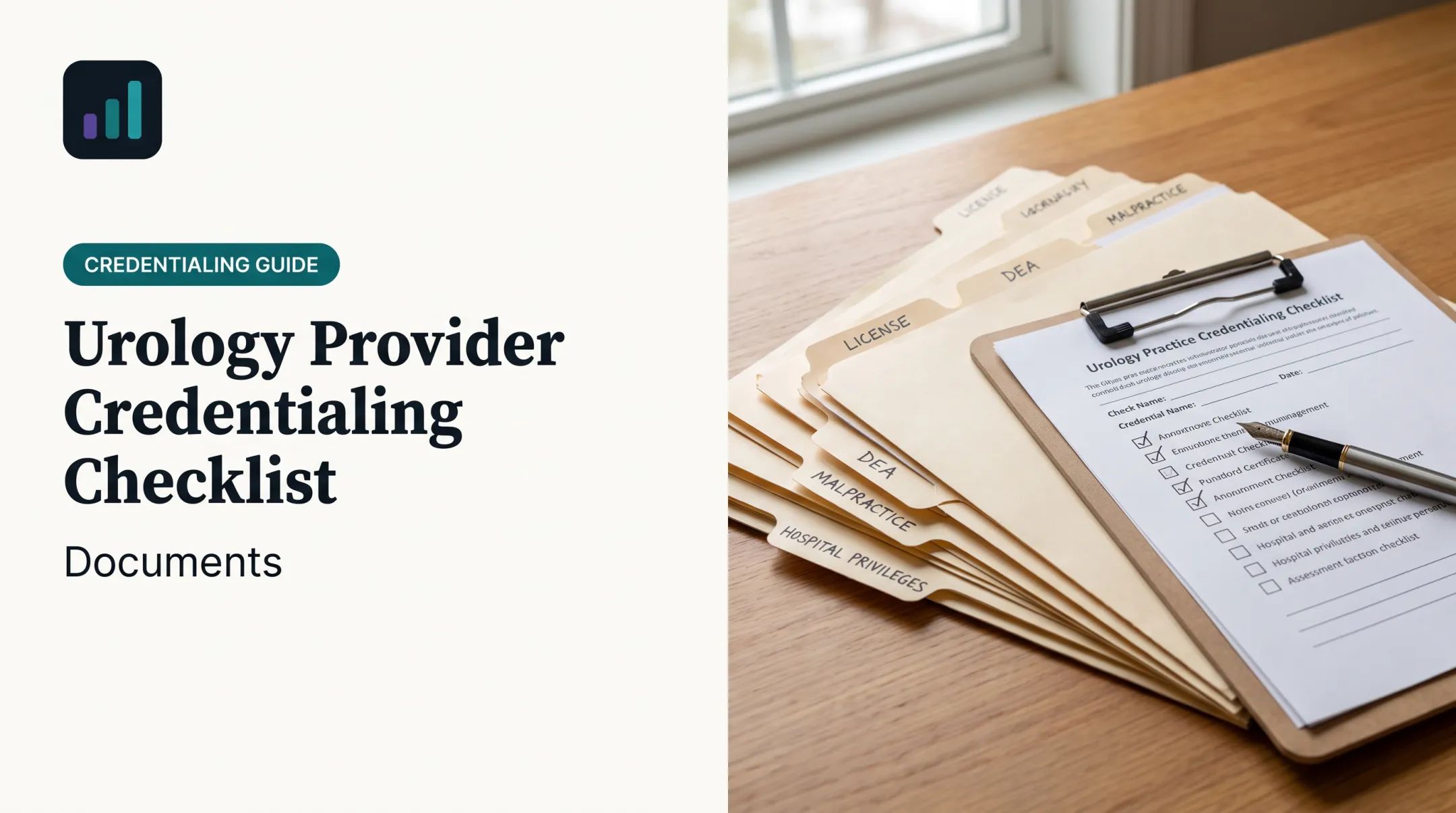
A practical checklist typically includes:
- Current CV with no unexplained gaps
- Medical school and postgraduate training records
- Board status and state license numbers
- DEA registration, where applicable
- NPI and taxonomy information
- Malpractice coverage and claims history
- Employment history and professional references
- Procedure logs and facility privilege history, if requested
Disclose everything. Explain gaps instead of leaving them blank. Requirements vary by payer and facility, so verify the final checklist against current bylaws and payer instructions rather than reusing last year's version.
Step 3: Perform Primary-Source Verification and Review
Credentialing staff verify information directly with licensing boards, medical schools, training programs, certifying bodies, prior employers, and malpractice carriers. According to NCQA's 2025 credentialing guide, verification must come from the primary source, a recognized source, or a contracted agent of that source.
Missing responses, inconsistent dates, or adverse findings typically trigger a clarification request or committee review, not an automatic denial. They do add time.
Step 4: Approve Credentials and Request Privileges
Internal review usually moves from department leadership to a credentials committee, then to a medical executive committee or governing board for the final decision. The privilege request itself should match verified training and current competence, not just what the physician hopes to perform.
Step 5: Complete Payer Enrollment and Activate the Workflow
Payer enrollment runs on its own track entirely. It requires accurate provider, group, tax ID, and location data, and it does not finish automatically when credentialing does.
Confirm three things in writing before treating any payer as active:
- The effective date of participation
- Network status and billing identifiers
- Claim-submission requirements specific to that payer
Some payers permit backdating claims to the application receipt date. Some don't. That difference can represent an entire month of collectible revenue, so confirm the rule for each payer rather than assuming.
Step 6: Maintain, Monitor, and Recredential
Credentialing doesn't end at approval. License renewals, DEA registration, malpractice coverage, and payer attestations all need ongoing tracking. A centralized expiration calendar with assigned ownership catches a lapsed credential before it becomes a billing problem.
CMS requires Medicare enrollment revalidation generally every five years. Facility and commercial-payer intervals differ and should be confirmed against current bylaws rather than assumed uniform.
Where the Process Applies, What Affects It, and Common Issues
Where Credentialing Is Used
Credentialing isn't a one-time event tied to a hire date. It recurs across:
- Initial onboarding at a new independent practice
- Adding a hospital or ASC location
- Applying to a new payer
- Changing groups or expanding procedure privileges
- Periodic recredentialing cycles
Each scenario carries its own requirements for practice participation, facility privileges, and payer enrollment.
What Affects Timing, Cost, and Complexity
Provider-specific factors that slow review include:
- Number of prior employers and unexplained gaps
- Malpractice claims or multiple state licenses
- Requested procedures that need additional review
Organization-specific factors include application format, committee meeting schedules, primary-source response speed, and whether multiple locations or payers are involved at once.
Cost categories worth planning for, rather than a single figure:
- Internal staff time
- Document retrieval and verification
- Application or enrollment fees
- Credentialing software or outsourced services
- Lost or delayed revenue while approvals are pending
Common Issues and Misconceptions
A medical license or a signed employment offer doesn't mean a urologist is privileged at every facility or enrolled with every payer they'll need. Copying data from an old application is another frequent trap: it carries forward conflicting dates, stale addresses, or expired documents that trigger extra review.
Practical fixes that actually reduce delay:
- Start well before the planned start date
- Maintain one complete, current provider source file
- Assign a single owner per payer or facility request
- Respond to every request within the window given
- Document every submission and follow-up
GrowUrology's guidance for practices launching independently treats credentialing and enrollment as the critical path for the first eighteen months, not a side task running parallel to build-out. Treating credentialing as a side task is the single most common startup mistake called out in that guide, because credentialing runs longer than construction and gates every dollar collected afterward.
When Extra Review or an Alternative Workflow May Be Needed
Unusual training history, adverse professional findings, or a privilege request that exceeds documented experience usually means additional evidence or committee consideration, not automatic rejection.
For administration itself, three models exist:
| Model | Works best when | Limitation |
|---|---|---|
| In-house | Volume is manageable and staff has bandwidth | Requires dedicated training and backup coverage |
| Outsourced | Volume is high or expertise is thin internally | Practice still owns the final decision |
| Hybrid | Some payers or facilities need closer control | Requires clear division of responsibility |
Software or an outsourced vendor can organize documents and speed up administrative steps. Neither one replaces the practice's, facility's, or payer's responsibility to make the actual credentialing and privileging decision.
Conclusion
Credentialing is a documented verification process, not a formality to get through on the way to opening your doors. It supports safe practice, facility access, and the payer relationships your revenue depends on.
Treat credentialing, privileging, and payer enrollment as connected but separate workstreams, each with its own owner, its own documents, and its own realistic timeline. Request retroactive payer effective dates in writing early, since some payers backdate to application receipt and some don't.
A few habits keep the process on track:
- Start before you sign a lease
- Disclose completely
- Verify against current requirements instead of last year's checklist
- Monitor what you've already gotten approved, because recredentialing doesn't wait for a convenient moment
Frequently Asked Questions
What is physician credentialing?
Physician credentialing is the collection, primary-source verification, and formal review of a physician's qualifications and professional history. It's distinct from facility privileging and from payer enrollment, which are separate approval tracks.
What is the purpose of physician credentialing?
It confirms a physician's education, training, licensure, and professional standing to support patient safety and organizational risk management. It's also a prerequisite for facility approval and, where applicable, payer participation.
What are the steps involved in the physician credentialing process?
The process covers defining requirements, collecting the application and supporting documents, primary-source verification, committee review and approval, facility privileging, payer enrollment, and ongoing monitoring or recredentialing.
What documents are required for physician credentialing?
Common requirements include a current CV, education and training records, state licenses, board status, malpractice history, employment history, references, and identifiers like an NPI. Exact requirements vary by facility and payer.
How long does physician credentialing take?
There's no universal timeline. Completeness of the application, primary-source response times, committee schedules, payer processing, and the number of locations involved all affect how long it takes.
What happens if a physician is not credentialed?
The physician may be unable to receive certain privileges, treat patients under a facility's rules, or bill participating payers for services rendered. Practices should resolve these gaps before the physician begins the affected services.