Introduction
Medical coding management goes beyond picking a diagnosis code and a CPT code. For an independent urology practice, it runs as a financial control system, an operational workflow, and a compliance safeguard at the same time.
Denial rates show the stakes. MGMA data shows an 8% aggregate first-submission denial rate across single-specialty practices, and a 2024 poll found 60% of practices reporting higher denials than the year before, according to MGMA's RCM report.
Every denial means delayed cash, rework, and staff time pulled from patient care.
This article walks through what coding management actually covers, how to build the workflow around it, the compliance guardrails that keep it defensible, and where people, technology, and outside partners fit in.
Key Takeaways
- Coding management coordinates documentation, code selection, claims readiness, payer rules, audits, and corrective action
- Accuracy hinges on complete provider documentation, current coding guidance, payer-specific rules, and consistent internal review
- Audits work best when they find root causes, not just flag post-payment errors
- Technology extends staff capacity, but complex or ambiguous cases still need qualified human review
What Urology Medical Coding Management Includes
Coding, billing, and revenue cycle management (RCM) are often used interchangeably, but they're distinct functions:
| Function | What it does |
|---|---|
| Coding | Reviews documentation and translates procedures, diagnoses, and supplies into CPT, HCPCS Level II, and ICD-10-CM codes |
| Billing | Takes those codes and processes claim forms with payers |
| RCM | Tracks revenue from scheduling through final payment, including eligibility, charge capture, claims, and denials |
Coding management is the connective tissue. It governs how documentation turns into codes, how codes turn into clean claims, and how claim outcomes feed back into provider education and policy.
Core Responsibilities
A functioning coding management process covers:
- Interpreting provider documentation for completeness and specificity
- Selecting supported ICD-10-CM, CPT, and HCPCS Level II codes
- Applying modifiers correctly, including sequencing and payer-specific requirements
- Validating medical necessity before a claim goes out
- Preparing claims that will pass payer edits on the first attempt
Where Urology Needs Extra Attention
A few areas carry outsized denial and audit risk in urology, though practices should always confirm specifics against current AUA, CMS, and payer guidance before acting:
- Office and E/M services - level selection based on medical decision-making or time, plus modifier 25 for a significant, separately identifiable E/M on the same day as a procedure
- Procedures and bundling - catheterization (51701-51703) isn't separately reportable when integral to surgery; cystoscopy with multiple biopsies (52204) bills as one unit (CMS NCCI policy manual)
- Diagnostic testing - urodynamics requires documented medical necessity and a supported diagnosis
- Injections and supplies - buy-and-bill drugs like onabotulinumtoxinA carry wastage reporting (JW/JZ modifiers) and authorization risk
- Global periods - modifier 57 versus 24 depends on whether postoperative E/M is related to the original surgery
Denial trends, payer edits, underpayments, and charge lag matter more as a pattern than as isolated incidents. A revenue leakage review of common failure points, such as missing procedure charges or contractual underpayment, often surfaces a process problem long before any single claim looks wrong.

How to Build a Urology Coding Management Workflow
Coding management only works if it's mapped as a full workflow, not a single department's task list.
Map the Full Workflow
Map every stage from front desk to finance:
- Scheduling, eligibility verification, and prior authorization
- Documentation and charge capture
- Coding and claim edits
- Submission, payment posting, and denial follow-up
- Reporting
Ownership shifts at each handoff:
- Clinical staff own documentation and charge entry
- Coders own code selection and modifier application
- Billers own claim submission and payment posting
- Practice leadership owns denial trend review and policy updates
Assign a named owner and backup for the authorization queue. Start the clock at order entry, not first submission. That closes one of the most common gaps between scheduling and clean claims.
Write It Down
Written coding policies should specify:
- Documentation expectations and provider query practices
- Code-update procedures and modifier use
- Payer-specific rules and escalation paths
- How exceptions get recorded
Without this, institutional knowledge lives in one coder's head and disappears when they leave.
Build the Feedback Loop
- Deliver focused provider education tied to recurring error patterns
- Clarify documentation gaps with specific, concrete examples
- Track whether corrective action actually resolved the original issue, not just whether training happened
Audit by Risk, Not Randomly
A risk-based audit samples across providers, services, payers, and complexity levels. The HHS-OIG recommends at least one audit annually for small practices, scaled to risk, according to OIG's compliance guidance. Focused reviews should happen more often when a problem area emerges.
Run Root-Cause Analysis
When an error surfaces, pin the root cause to one source: documentation, code selection, charge capture, system configuration, training, payer policy, or a workflow handoff. Assign an owner and a follow-up date. Work one category per month, starting with the largest root cause by dollar value, not just by volume.

Track the Right Dashboard
A concise reporting routine should cover:
- Coding turnaround time
- Claim rejection reasons and denial categories
- Corrected-claim volume
- Documentation query trends and audit findings
If more than roughly a fifth of denials land in an "other" or "unclassified" bucket, fix the taxonomy before analyzing anything else.
Quality, Compliance, and Performance Management
Every code billed needs to be supported by what's actually documented in the record. That sounds obvious, but it's where most compliance exposure starts.
What to Avoid
- Upcoding - billing a higher level of service than documentation supports
- Unbundling - billing components separately that one code already covers
- Unsupported modifiers - applying modifier 59 or an X{EPSU} subset without a documented, distinct service
- Cloned documentation - copying forward notes without updating or verifying accuracy
- Reimbursement-driven coding - selecting a code because it pays better, not because it matches the service rendered
Stay Current on the Rules That Change Every Year
Annual ICD-10-CM updates, CPT changes, NCCI edits, Medicare coverage policy, and local coverage determinations (LCDs) all shift on their own schedules. Commercial payers often diverge further still. A Medicare Administrative Contractor's LCD, for instance, determines what's "reasonable and necessary" only within its own jurisdiction. A rule that applies in one region may not transfer to another.

Query Providers Without Leading Them
Compliant queries clarify the clinical picture without steering the provider toward a specific diagnosis, service level, or procedure. Guidance from AHIMA and ACDIS calls for queries built on relevant clinical indicators, phrased to allow multiple possible responses rather than one desired answer.
Layer Your Checks
No single accuracy check catches everything. Combine:
- Pre-bill edits that catch errors before submission
- Targeted post-bill audits on high-risk codes and modifiers
- Denial analysis sorted by root cause and dollar value
- Periodic policy review as payer rules shift
Protect the Data
When coding work runs through software or an outside partner, PHI safeguards still apply. That means role-based access controls, audit trails, business associate agreements, and vendor oversight. Outsourcing a task never outsources the compliance responsibility.
Coding rules and payer policies change frequently. The guidance here reflects general practice; confirm specific decisions against current official sources or qualified compliance counsel before acting.
People, Technology, and Outsourcing Options
Unclear ownership is how documentation and claim problems repeat month after month.
Role boundaries should stay explicit:
- Providers own clinical documentation
- Coders own code selection and modifier logic
- Billers own claim submission
- Administrators and revenue-cycle leaders own policy, reporting, and vendor oversight
When those lines blur, errors slip through unchecked.
Manual, Automated, or Hybrid
| Approach | Strength | Limitation |
|---|---|---|
| Manual review | Catches nuance and ambiguity | slower, harder to scale |
| Encoder/automated suggestions | Prioritizes work, flags inconsistencies fast | Can't replace judgment on complex cases |
| Hybrid | Combines speed with expert oversight | Requires clear escalation rules |
Automation is useful for triage. It shouldn't be the final word on a complicated case.
Choosing In-House, Outsourced, or Hybrid
Evaluate each option on:
- Specialty-specific coding experience
- Communication responsiveness
- Audit methodology and transparency
- Payer knowledge, including Medicare and regional commercial plans
- Security controls and BAA compliance
- Reporting detail
- Coverage during staff absences
- Total operating cost, not just per-claim rate
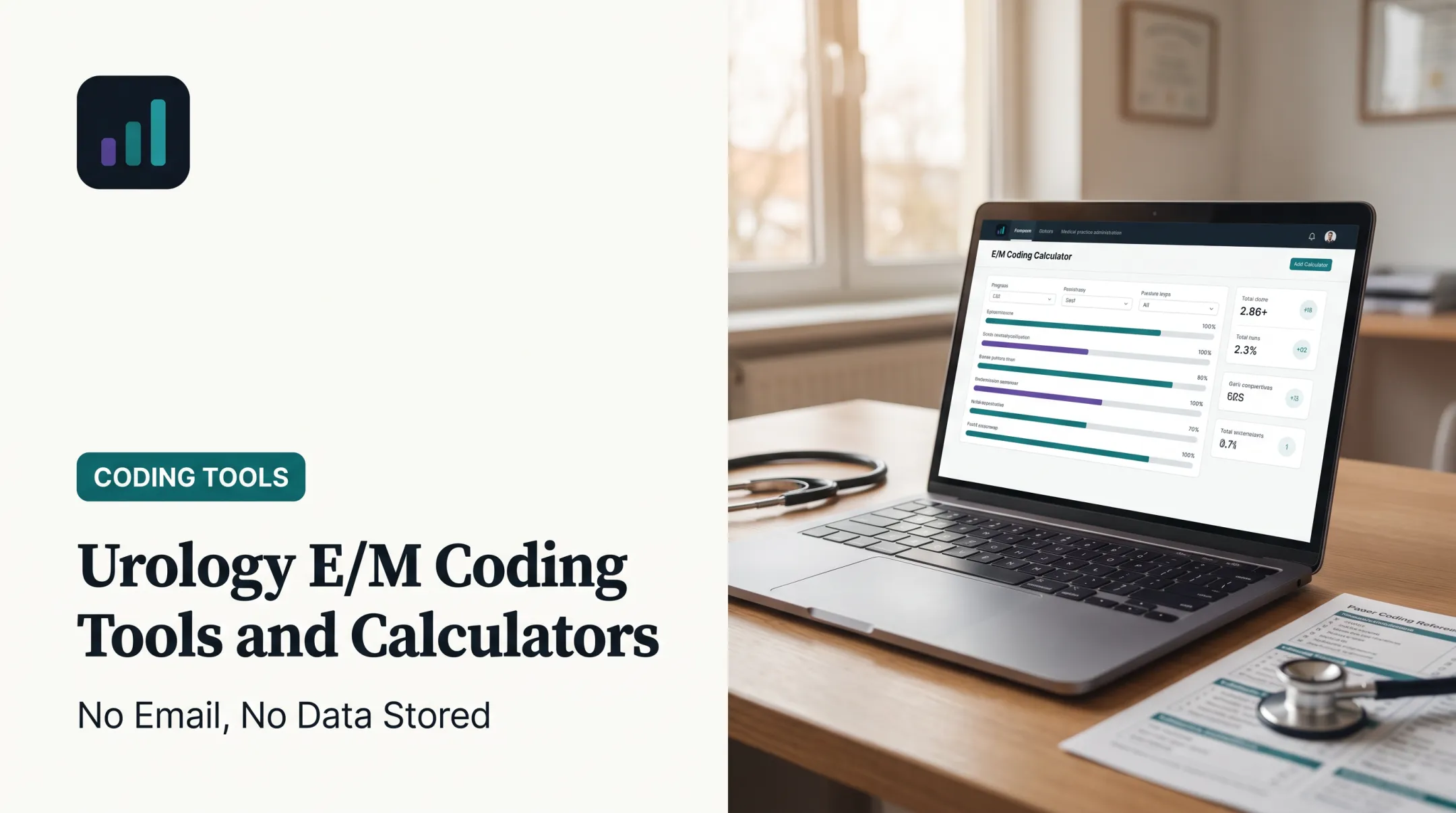
Practices comparing these trade-offs can use GrowUrology's free, ungated calculators and plain-English guides to work through capacity, reimbursement, and scaling questions themselves. GrowUrology is published and funded by Persistex, a Massachusetts-based medical billing and coding firm. The tools are informational, not a sales pitch.
Frequently Asked Questions
What skills do you need to be a coder?
Coders need working knowledge of medical terminology, anatomy and physiology, ICD-10-CM, CPT, HCPCS, payer rules, and documentation analysis. Attention to detail, clear communication, ethics, and continuing education matter equally.
What does urology medical coding management include?
It covers coding standards, documentation review, charge capture, claim edits, audits, denial analysis, staff education, compliance, and performance reporting. The scope runs from documentation through payment, not code assignment alone.
How does accurate coding affect a urology practice's revenue cycle?
Accurate documentation and code selection lead to cleaner claims, appropriate reimbursement, and fewer avoidable denials. It also improves reporting reliability and cuts down on rework for staff.
Which urology services require especially careful coding and documentation?
E/M services, procedures with bundling rules, urodynamics and other diagnostics, injections and supplies, modifiers, and global-period rules all carry extra risk. Always verify specifics against current CMS and payer guidance.
How often should a urology practice audit its medical coding?
Frequency should reflect service complexity, payer risk, error trends, and prior findings. Most practices benefit from at least one annual audit, with targeted reviews whenever recurring issues appear.
When should a urology practice consider outsourcing coding management?
Warning signs include persistent denials, staff capacity constraints, inconsistent audit results, limited urology-specific expertise, weak reporting, or trouble keeping up with changing coding and payer requirements.